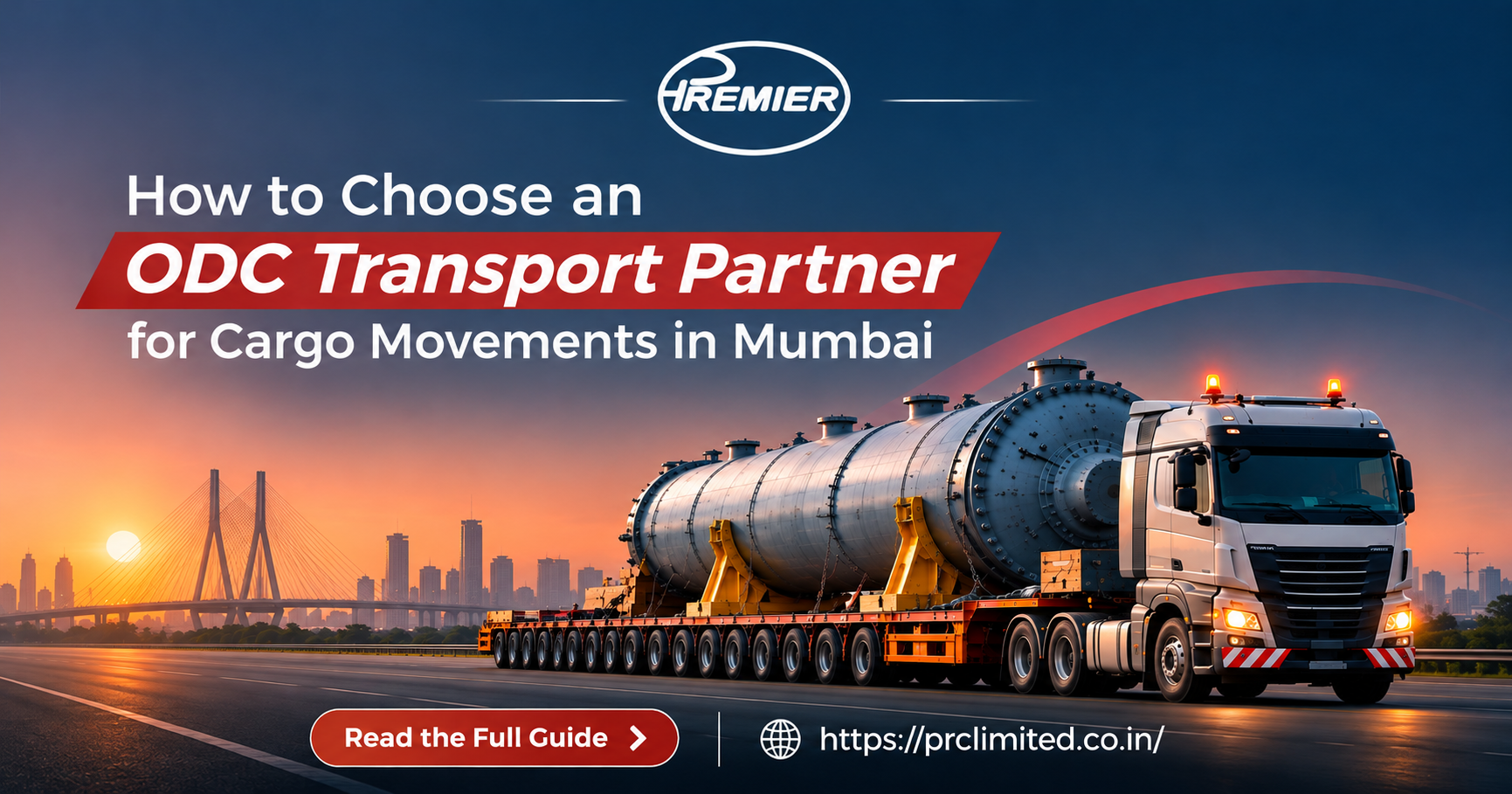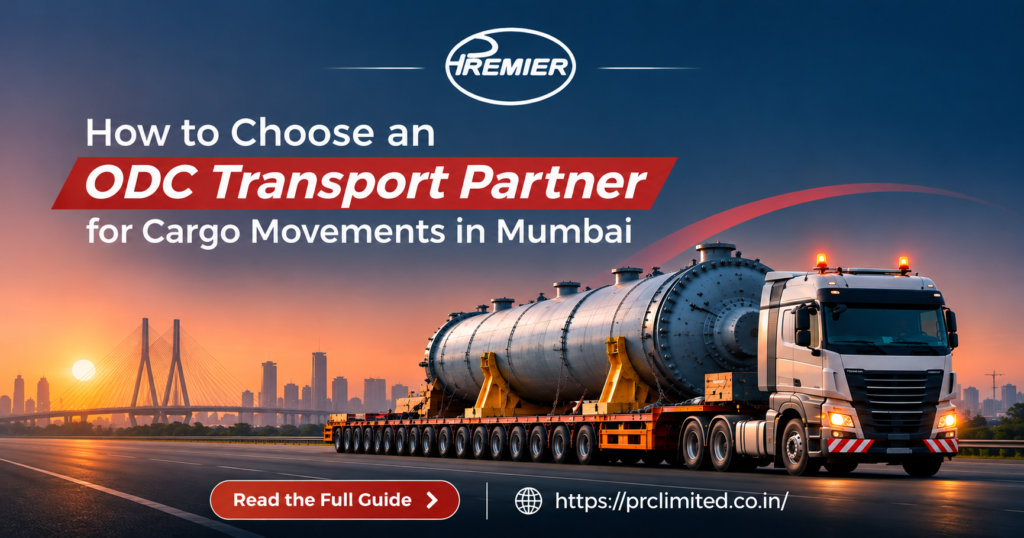
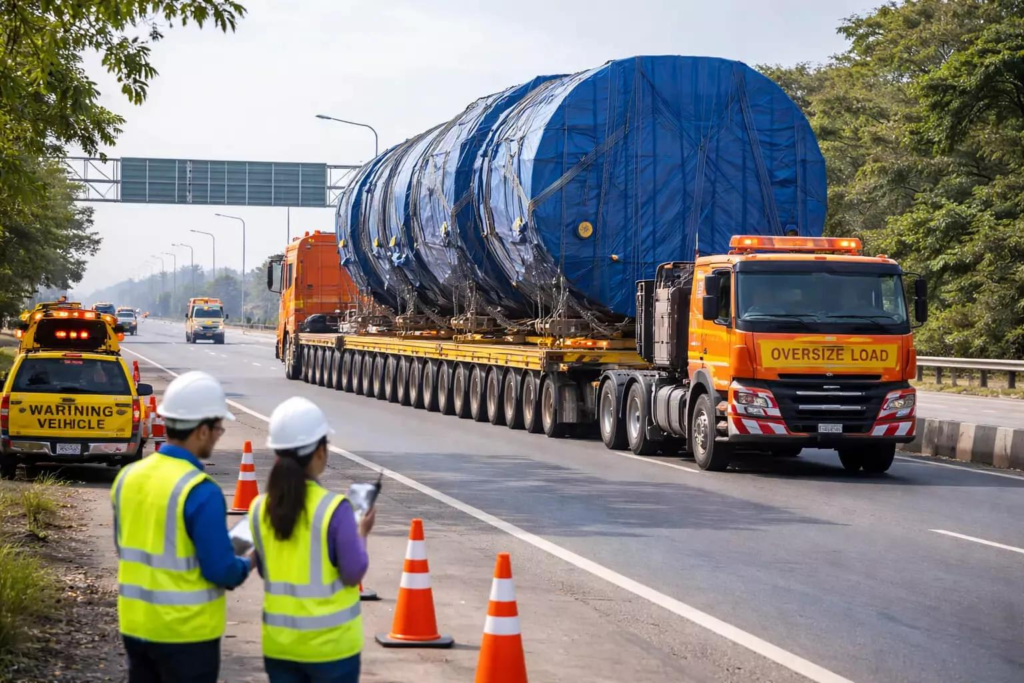
Moving oversized industrial equipment is not the same as arranging conventional road transportation. A transformer, turbine, industrial vessel, boiler or heavy machinery component may require specialised trailers, route feasibility assessment, regulatory coordination and carefully planned loading and unloading.
For businesses arranging ODC transportation in Mumbai, selecting the right logistics partner is therefore an important project decision.
A transporter may offer an attractive freight quotation, but that alone does not establish whether the proposed vehicle is suitable, the route is feasible or the complete movement has been planned.
The right ODC transport partner should understand the cargo, assess the route, recommend an appropriate transportation arrangement and explain how the movement will be coordinated from pickup to delivery.
This guide explains nine important factors businesses should evaluate before selecting an ODC transport company in Mumbai.
Why Choosing an ODC Transporter Requires Careful Evaluation
Over Dimensional Cargo (ODC) refers to cargo that exceeds applicable standard vehicle or transportation dimensions. Some movements may also involve overweight consignments, which introduce additional technical and regulatory considerations.
Unlike conventional freight, ODC transportation depends on several connected factors:
- Cargo length, width, height and gross weight
- Weight distribution and centre of gravity
- Trailer configuration and axle arrangement
- Route conditions and infrastructure limitations
- Applicable permissions and documentation
- Loading, securing and unloading arrangements
- Pickup and destination-site accessibility
A problem in one area can affect the entire movement plan.
For example, a trailer may appear suitable based on the cargo’s weight, but its loaded height could create clearance challenges along the proposed route. Similarly, a feasible highway route does not automatically guarantee that the vehicle can access the final delivery location.
This is why businesses should evaluate an ODC transporter on its planning and execution capabilities, not simply on vehicle availability.
9 Factors to Evaluate Before Choosing an ODC Transport Company in Mumbai
1. Experience with Similar ODC Cargo
The first consideration should be the transporter’s experience with cargo similar to yours.
Handling an industrial transformer is different from transporting a long structural component or an oversized machinery assembly. Each type of cargo may have different loading, positioning, securing and transportation requirements.
Ask the transporter:
- Have you handled cargo with similar dimensions and weight?
- Have you transported similar industrial equipment?
- Can you share relevant completed project examples?
- What was your role in those movements?
- Can you explain the challenges encountered and how they were addressed?
Do not evaluate experience only through the number of years a company has been operating.
Relevant experience should demonstrate an understanding of the cargo type, transportation requirements and complexity of the movement.
2. Check Whether the Proposed Trailer Is Suitable
There is no single trailer configuration suitable for every ODC consignment.
Depending on the cargo and transportation requirements, different configurations may be considered, including:
- Low-bed trailers
- Semi-low-bed trailers
- Multi-axle trailers
- Hydraulic axle systems
- Extendable trailers
- Other specialised heavy-haul arrangements
The correct selection depends on more than the cargo’s gross weight.
The transporter should consider:
- Cargo dimensions
- Gross weight and weight distribution
- Centre of gravity
- Loaded vehicle height
- Axle arrangement and loading
- Route conditions
- Loading and unloading requirements
What to ask: Why has the transporter recommended this particular trailer configuration for your cargo?
A professional recommendation should be supported by the cargo specifications and transportation assessment.
3. Understand the Route Survey and Feasibility Process
Route feasibility is one of the most important aspects of ODC transportation.
A route suitable for a conventional truck may not be suitable for an oversized vehicle. The transporter’s team should evaluate the proposed route based on the actual cargo and loaded vehicle configuration.
Important considerations may include:
- Bridge and culvert conditions
- Overhead electrical lines and other obstructions
- Road width and turning radius
- Road gradients and surface conditions
- Restricted sections and potential diversions
- Access to the loading and unloading locations
For complex movements, ask whether the transporter conducts a physical route survey or another suitable feasibility assessment.
Also clarify whether the assessment covers the complete route, including the final approach to the destination.
A useful question to ask: Will the proposed route be assessed using the actual loaded vehicle dimensions, or is the recommendation based only on a standard road route?
4. Clarify Responsibility for Applicable Permissions
ODC movements may require specific permissions depending on the cargo, vehicle configuration, route and applicable regulatory requirements.
For example, the Ministry of Road Transport and Highways issued a circular dated 10 June 2020 covering online permission for single-unit ODC/OWC consignments on specified modular hydraulic trailers on National Highways.
The circular includes requirements relating to transporter and vehicle documentation, cargo dimensions, gross weight, axle details and route information.
However, this should not be interpreted as one universal permission process for every ODC movement. Requirements must be assessed against the actual consignment and route.
Before appointing a transporter, clarify:
- Which permissions may apply to the proposed movement?
- Who will coordinate the applications?
- Which documents must the shipper provide?
- Who will communicate with the relevant authorities?
- How will changes in route or movement conditions be handled?
Responsibility for regulatory coordination should be clearly established before dispatch.
5. Evaluate Loading, Lashing and Cargo-Securing Knowledge
Transportation planning does not end with selecting a trailer.
The cargo must also be loaded, positioned and secured appropriately for the journey.
Improper positioning or inadequate securing can create movement and stability risks during transportation.
Ask the transporter how the loading and securing arrangement will be assessed.
Important considerations include:
- Cargo lifting and loading requirements
- Positioning on the trailer
- Weight distribution
- Centre of gravity
- Lashing and securing arrangements
- Protection of sensitive equipment
- Unloading requirements at the destination
For high-value or sensitive machinery, the shipper should also clarify the responsibilities of the transporter, crane contractor, loading team and receiving site.
6. Check Escort and Movement Coordination Requirements
Certain ODC movements may require pilot vehicles, escorts or additional coordination depending on the route, cargo configuration and applicable permissions.
The transporter should explain how movement coordination will be handled.
Ask:
- Is a pilot or escort vehicle required?
- Who will arrange the necessary coordination?
- How will movement instructions be communicated?
- Who will be the primary contact during transportation?
- How will delays or route-related issues be escalated?
The objective is to establish clear responsibility throughout the movement.
Avoid accepting broad claims such as “complete escort support” without understanding what is actually included in the proposed scope.
7. Evaluate Mumbai-Specific Pickup and Delivery Considerations
Mumbai-related ODC movements can involve different transportation scenarios.
For example:
Port-origin cargo: Equipment arriving through a port may require coordination between cargo availability, documentation, terminal-related processes, vehicle planning and onward transportation.
Industrial-origin cargo: Machinery moving from an industrial facility may require assessment of factory access, loading space, lifting arrangements and the connection to the main route.
Project-site delivery: Even when the highway journey is feasible, the final approach may involve restricted access, limited turning space or site-readiness considerations.
These are different operational situations and should not be treated as identical transportation assignments.
When evaluating a transporter, check whether the proposed scope considers the complete journey from the actual pickup point to the final delivery location.
Do not assume that a company’s general presence in Mumbai automatically means every pickup and delivery location is accessible for every ODC configuration.
8. Ask for Evidence of Relevant Project Execution
A transporter’s project experience should be supported by relevant examples.
Instead of asking only for a general company profile, request details of comparable completed movements.
Useful information may include:
- Type of cargo transported
- Cargo dimensions and weight
- Origin and destination
- Trailer configuration used
- Scope of work handled
- Route or operational challenges
- Photographs or project documentation, where available
A project involving a similar cargo type can provide more useful evidence than a generic list of industries served.
For complex assignments, also clarify whether the transporter handled only road transportation or additional activities such as loading, unloading, route coordination or site placement.
This distinction helps businesses compare service scopes accurately.
9. Compare the Complete Transportation Scope, Not Just the Freight Rate
Two ODC quotations may appear similar while covering very different services.
One quotation may include only transportation, while another may include route assessment, permit coordination, loading support, escort arrangements or unloading activities.
Before comparing prices, check whether both proposals cover the same scope.
Consider the following:
| Evaluation area | What should be clarified? |
|---|---|
| Trailer | Proposed vehicle and configuration |
| Route survey | Whether feasibility assessment is included |
| Permissions | Applicable approvals and responsibility |
| Loading | Crane, labour and loading supervision |
| Securing | Lashing and cargo-protection arrangements |
| Escort | Pilot or escort requirements |
| Unloading | Equipment and site responsibilities |
| Insurance | Coverage, exclusions and responsibility |
| Additional costs | Diversions, waiting, handling and other charges |
| Communication | Movement coordination and escalation contact |
A lower initial quotation is not necessarily the most economical option if important activities are excluded and later charged separately.
The objective should be to compare the complete scope, responsibilities and potential cost implications before approving the movement.
GET IN TOUCH
Schedule a Call
How to Compare ODC Transport Quotations in Mumbai
Before finalising a transporter, use a structured evaluation rather than relying on price alone.
| Evaluation criterion | Suggested review |
|---|---|
| Relevant ODC experience | Evidence of similar cargo movements |
| Equipment suitability | Explanation of proposed trailer configuration |
| Route feasibility | Clear route assessment process |
| Regulatory coordination | Defined responsibilities for applicable permissions |
| Cargo handling | Loading and securing methodology |
| Movement planning | Escort and coordination requirements |
| Project evidence | Relevant completed assignments |
| Commercial transparency | Complete scope and exclusions |
| Communication | Named contact and escalation process |
For procurement teams, it can also be useful to score each shortlisted transporter against the same criteria.
This makes the comparison more consistent and helps identify gaps before a purchase order or transportation contract is issued.
Information to Share When Requesting an ODC Transport Quote
A transporter cannot prepare a meaningful transportation proposal without understanding the cargo and movement requirements.
Businesses should prepare the following information before requesting a quotation:
| Information | Details to provide |
|---|---|
| Cargo description | Equipment or machinery name |
| Dimensions | Length × width × height |
| Gross weight | Actual cargo weight |
| Cargo quantity | Number of units |
| Pickup location | Full origin address |
| Delivery location | Full destination address |
| Loading arrangements | Available crane, lifting equipment or loading support |
| Unloading arrangements | Site equipment and unloading requirements |
| Cargo photographs | Recent photographs from different angles |
| Technical drawings | Available cargo drawings and lifting points |
| Required delivery timeline | Expected dispatch and delivery window |
For complex cargo, technical drawings and photographs can help the transporter understand the shipment before recommending an arrangement.
The final transportation proposal should be based on verified cargo details and the actual route requirements.
How PRCL Approaches ODC Transportation
Premier Road Carriers Limited (PRCL) provides ODC transportation as part of its logistics services.
Its published ODC service information describes capabilities relating to route survey and feasibility, government coordination, escort movement and loading/bracing knowledge.
PRCL also publishes completed ODC project examples, including a movement from Mumbai Port to Delhi Metro involving a 75 MT consignment transported using a hydraulic axle arrangement.
This is a useful example of why project evidence matters when evaluating an ODC transportation partner: the cargo, route and transportation arrangement should be considered together.
Businesses planning oversized industrial equipment or project cargo movements can explore PRCL’s ODC transportation services and its logistics services in Mumbai.
For a transportation assessment, share the cargo dimensions, weight, pickup location, destination and expected timeline so that the requirements can be evaluated.
Frequently Asked Questions
1. How do I choose an ODC transport company in Mumbai?
Evaluate the company’s experience with similar cargo, proposed trailer configuration, route survey process, applicable permission coordination, loading and securing knowledge, project references and complete quotation scope.
2. What information is required to book ODC transportation?
You should provide cargo dimensions, gross weight, cargo description, pickup and delivery locations, photographs, technical drawings where available, loading requirements and the expected transportation timeline.
3. Why is a route survey important for ODC transportation?
A route survey helps assess whether the proposed loaded vehicle can safely and feasibly travel along the selected route. It may identify bridge limitations, overhead obstructions, road-width restrictions, turning challenges and potential diversions.
4. Which trailer is used for ODC transportation?
The trailer depends on the cargo’s dimensions, weight, weight distribution, centre of gravity and route conditions. Depending on the requirement, low-bed, semi-low-bed, multi-axle or hydraulic axle configurations may be considered.
5. Are permits required for every ODC movement?
Permission requirements depend on the cargo, vehicle configuration, route and applicable regulations. Certain movements on National Highways have specific permission procedures. The transporter should assess the actual shipment before confirming the applicable requirements.
6. What affects the cost of ODC transportation in Mumbai?
Cost may depend on cargo dimensions and weight, trailer configuration, route distance, route conditions, applicable permissions, loading and unloading requirements, escort arrangements and any additional handling or infrastructure requirements.
7. Can an ODC transporter handle cargo from Mumbai Port?
This depends on the transporter’s actual service scope, the cargo, port-related requirements and the onward route. Confirm the responsibilities for documentation, cargo availability, terminal coordination and road transportation before appointing a transporter.
Final Checklist Before Selecting an ODC Transporter
Before approving an ODC transportation proposal, confirm:
- Has the transporter handled similar cargo?
- Has the cargo’s actual dimensions and weight been reviewed?
- Is the proposed trailer suitable for the movement?
- Has route feasibility been assessed?
- Are applicable permission responsibilities clear?
- Have loading and securing arrangements been discussed?
- Are escort and movement coordination requirements understood?
- Has the final delivery location been considered?
- Are inclusions, exclusions and additional costs documented?
- Can the transporter provide relevant project references?
Choosing an ODC transportation partner is ultimately about selecting a company that understands the complete movement—not simply arranging a vehicle.
A well-evaluated transportation proposal should connect cargo specifications, equipment selection, route feasibility, regulatory coordination and final delivery requirements into one clearly defined plan.